
Cass County Parole and Probation
Probation is a court-ordered form of supervision. It may let a person remain in the community instead of serving all or part of a term in jail or prison. Parole follows a release from state prison based on a Missouri Parole Board decision. Conditional release also follows prison, but it is a statutory supervised part of a qualifying sentence. Each status can place a Cass County resident under the Missouri Department of Corrections Division of Probation and Parole.
A person on parole or conditional release has left prison but has not reached final discharge. Someone on probation may never have entered a Missouri prison for that case. The current Cass County jail roster cannot settle either question. It reports present local custody, while MODOC maintains the active supervision record and Missouri Case.net preserves the court action. A later arrest, hold, or violation may exist at the same time as an active supervision entry.
| Status | How it begins | Who controls it | What ends it |
|---|---|---|---|
| Probation | A court imposes a community supervision term | The sentencing court and MODOC field supervision | Court discharge or lawful completion |
| Parole | The Parole Board authorizes release from prison | Missouri Parole Board and MODOC | Board discharge or lawful completion |
| Conditional release | A statutory supervised term follows confinement | MODOC and the Parole Board | Final discharge after the supervised term |
Verify Cass County Post-Release Supervision
The MODOC active-offender search is the best public starting point for a known person. It accepts a DOC ID or a first and last name, includes aliases, and requires a CAPTCHA. Compare the result's date of birth and physical details before opening it. The search covers active prisoners, probationers, and parolees. It expressly leaves out discharged offenders, so an empty result does not prove that a Cass County supervision term ended.
- Search by DOC ID when it is known, since names and aliases can return more than one person.
- Compare the result list's name, date of birth, race, height, weight, sex, and DOC ID.
- Open the record and read “Assigned Location,” the assigned officer, sentence summary, and active or completed offenses.
- Treat a Probation and Parole district assignment as evidence of active field supervision, not proof of a home address or present physical location.
- Check Case.net for the Cass County judgment, probation order, warrant, or later court action.
- Contact the listed officer or the current district office when a specific status needs confirmation.
The public MODOC detail can expose an officer and phone number as well as the supervision location. Some information can still be withheld for safety, security, or confidentiality. MODOC identifies present offenses, sentence and judgment, conviction county, supervision term, conditions, officer location, custody or bond status, parole or conditional-release date, Board release decision, and prior convictions as information that may be open. The public web page does not display every item in every case, so an officer or focused records request remains part of the verification path.
Cass County Supervision at District 5S
MODOC's current directory places local service at District 5S-Belton. The office handles probation, parole, and conditional release for a seven-county district that includes Cass County. Its published workload of about 2,006 cases per year describes the whole district. It is not a Cass County release total and should not be used as one.
District 5S-Belton
Missouri Department of Corrections
Division of Probation and Parole
836 North Scott
Belton, MO 64012
816-322-1166
The official District 5S listing shows the current Cass County supervision office.
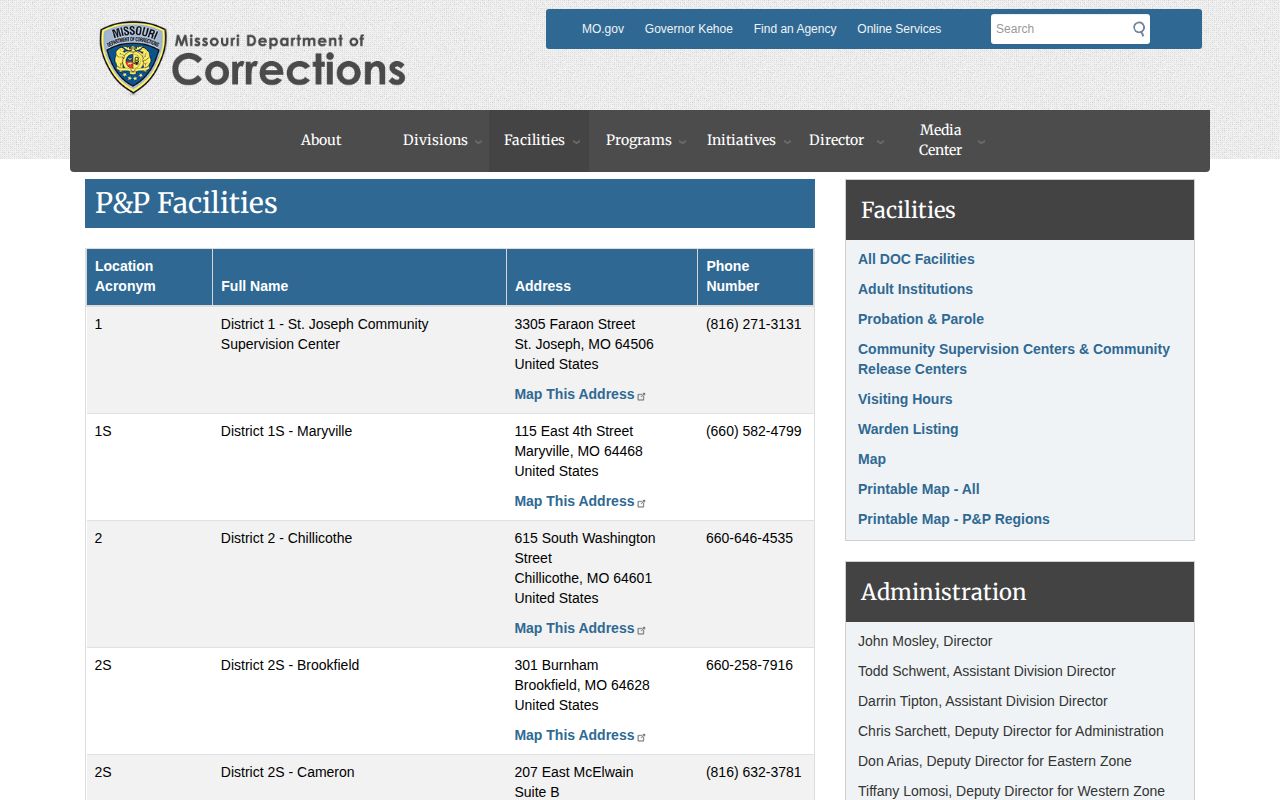
This captured directory is the source to check when older papers use a different district number or when an assigned location needs to be matched to a current office.
Why Cass Supervision Papers Say District 28
Older official documents call the Belton office District 28. Current MODOC materials call it District 5S-Belton. That change can make old release or supervision paperwork seem inconsistent even when it points to the same local service area. The number on an old form should not be read as proof that the office moved, supervision transferred, or the case ended.
Use the active-offender detail and current MODOC address directory together. If the online record names a field officer or office, that current assignment should guide the next contact. If no active result appears, seek the discharge order, court record, or MODOC record before drawing a conclusion. The active search is designed to omit discharged people, so the missing result has more than one possible explanation.
Cass County Supervision Violations
Standard and special conditions are rules attached to probation, parole, or conditional release. They differ by the judgment, Board action, and supervision plan. A violation may lead to an investigation, warrant, revocation process, or new custody event. It does not always mean the person is already back in jail. Likewise, an active supervision page can coexist with a local arrest or hold.
No official statewide, public, name-searchable MODOC absconder list was found. An absconder is a supervised person whose location and compliance are no longer known to the supervising agency. MODOC's Probation and Parole Command Center works with law enforcement on those cases, but that operational work is not a public lookup. Check the active MODOC record, Missouri Case.net, any official local warrant source, and the assigned office. VINELink can relay a reported custody change when a participating agency enters it, but it is not a warrant source.
Absconding can also change an expected supervision end. MODOC states that absconder months do not earn earned compliance credit, and abscond time does not count toward the required minimum period for that credit. A date copied from older paperwork may therefore be stale after a violation or absconding period. Current agency and court records should control.
How Cass County Supervision Ends
Early discharge is final discharge from probation, parole, or conditional release before the scheduled end. A court reduces or discharges probation. The Missouri Parole Board may discharge parole or conditional release. MODOC's current guidance says Board discharge is generally considered after three years in the community, or five years for dangerous felons, while statutory rules and the person's record still control.
Eligible earned compliance credit can reduce supervision by 30 days for each compliant month after the required conditions are met under Missouri Revised Statutes § 217.703. Exclusions, violations, absconding, and case-specific requirements matter. The rule is not a promise that every Cass County supervision term shrinks at the same rate. For a reliable end date, review the order or Board record rather than estimate from the original term.
Discharge differs from the day a person left prison. Prison release can begin parole or conditional release. Final discharge comes later and ends that correctional jurisdiction. Since MODOC's public search covers active offenders, a person may disappear after discharge. Confirm the change through the discharge order, Parole Board record, court file, assigned officer, or a focused MODOC Sunshine request. The broader Cass County released-inmate search path explains how the jail, court, VINE, and MODOC records answer different parts of a release.
Cass County Parole Hearing Records
The Missouri Parole Board works within MODOC. Eligibility depends on the offense, sentence, law in effect, prior commitments, and any consecutive terms. The 85-percent rule applies to statutory dangerous felonies under the governing law. It is not a universal parole formula. Some offenses are not eligible for parole at all, so the judgment and the DOC calculation must be reviewed together.
No official public, person-by-person Missouri hearing calendar or named decisions database was found. Board guidance describes the process instead. A parole-eligible person is scheduled within 90 days after reception, and a hearing is normally held about four months before minimum eligibility. Exact-date notice is generally supplied about 45 days before the hearing. Those are operating time frames, not public Cass County calendar entries.
A Board result may set a presumptive parole date, deny parole while setting conditional or maximum release, or schedule another hearing. A presumptive date still depends on conduct, required programs, and an acceptable release plan. It may change or be rescinded. Victim Services says a decision commonly takes about eight to twelve weeks, while hearing and program information is treated as confidential in the agency's public explanation.
The Missouri Parole Board resource page shows the official rules and guidance but not a searchable named calendar or decision archive.
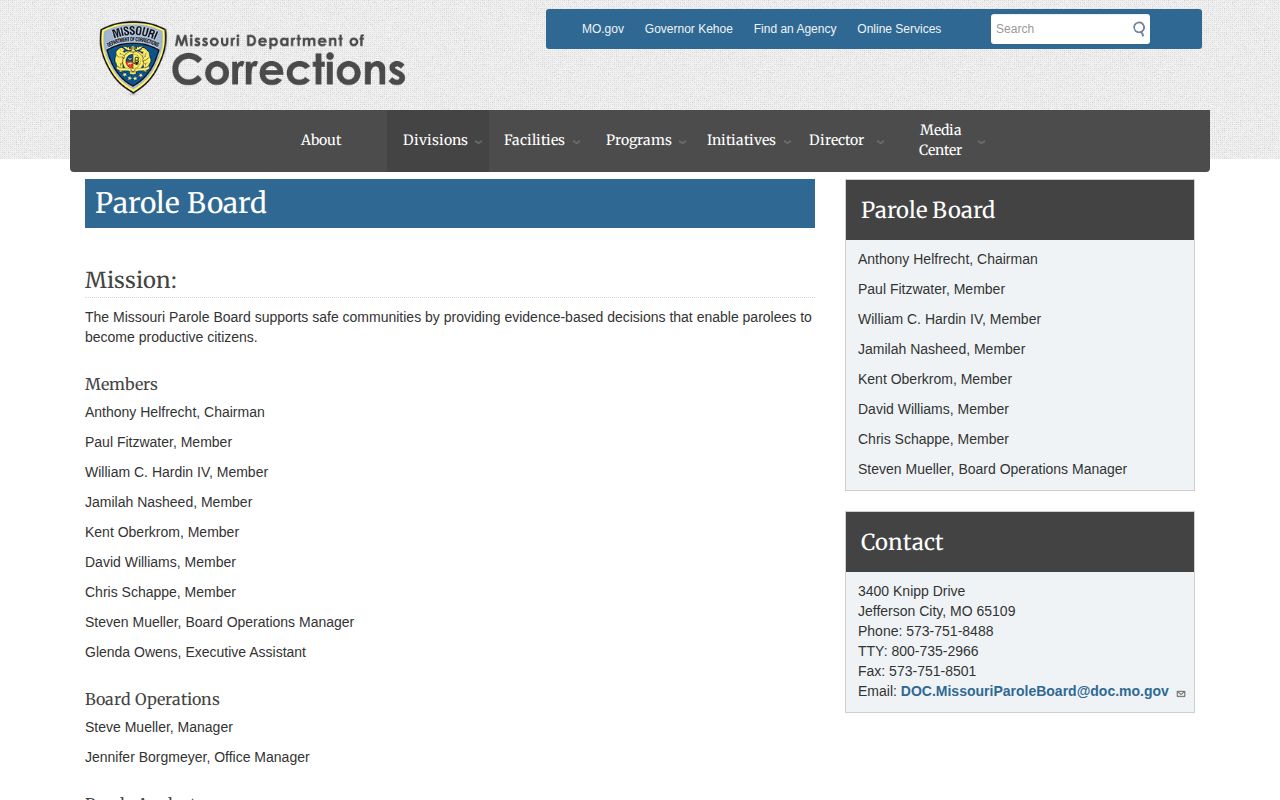
This captured page supports the records path: use the person's Notice of Board Action, institutional or field officer, authorized VINE notice, or a focused Board Sunshine request for a specific result.
Property After a Cass County DOC Transfer
A transfer from Cass County Jail to MODOC is not a release to the community. The county custody episode ends, but state confinement begins or continues. The Sheriff's local instructions provide a practical way to tell the two events apart: only authorized legal papers travel with the person on a DOC transport.
Before transport, the incarcerated person must make a written request that authorizes someone else to collect personal property. The recipient must present valid identification. Families should follow the Cass County Sheriff's DOC transport instructions before the move. Later, an institution shown as the MODOC assigned location supports continuing custody, while a Probation and Parole district supports the community-supervision phase.
This distinction prevents a common error. A name leaving the Cass County roster does not establish parole, probation, or community release. The receiving agency and the actual MODOC assignment provide the stronger evidence. Court orders can explain why a transfer was authorized, but they may not give the precise time the county booking closed.